 Vithupro Infotech
Vithupro Simulation
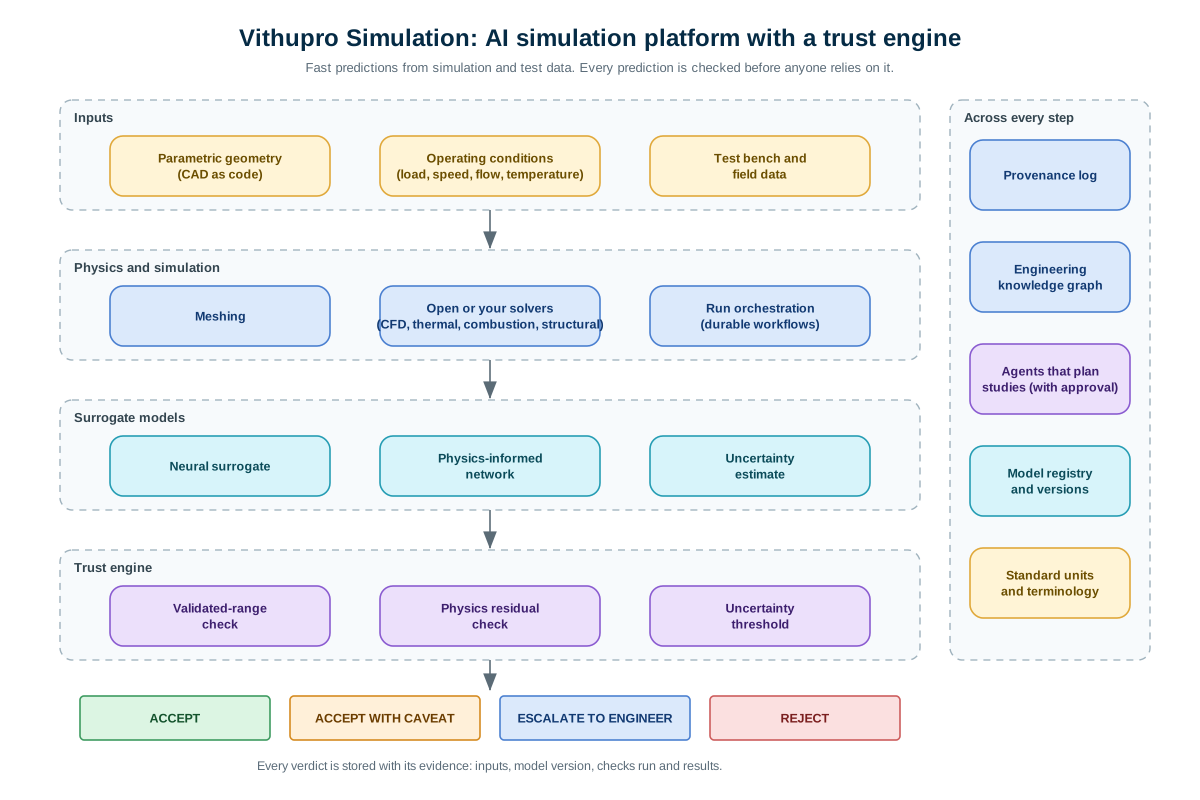
An AI simulation platform for engineering systems: engines, heat exchangers, turbines, pumps and more. Fast predictions from your simulations and test data, with a trust engine that checks every one before anyone relies on it.
What you can simulate
The same workflow for any system where physics or test data can be captured: set up the cases, run them, train a fast model, and check every answer.
Engines and gensets
Performance, combustion and emissions across the full load and speed map.
Heat exchangers
Thermal duty, pressure drop and the effect of fouling across operating conditions.
Turbines and compressors
Efficiency, temperatures and off-design behaviour across the operating map.
Pumps and fluid systems
Flow, pressure and losses in pumps, pipes, valves and networks.
Cooling and HVAC
Cooling circuits, HVAC equipment and electronics thermal management.
Your own system
Any system with a simulation model or test data behind it, from a single component to a full assembly.
The problem
Engineering teams need answers across the whole operating range, quickly, and they need to know which answers they can rely on.
Simulations are too slow to explore
A detailed CFD, combustion or structural simulation can take hours per design point, so teams check a few points and estimate the rest.
Fast models cannot say when they are wrong
A machine learning surrogate answers in milliseconds, but gives the same confident answer inside and outside the data it learned from.
Test data sits unused
Bench and field data in scattered files, with mixed units and missing test conditions, cannot be used to train or check a model.
What is inside
Geometry and parameters
- Parametric geometry written as code
- Design variables with valid ranges
- Operating conditions: load, speed, flow, temperature
Simulation runs
- Meshing and batch runs on open-source solvers or your own
- Fluid flow, heat transfer, combustion and structural cases
- Durable run orchestration with a full run log
Surrogate models
- Neural surrogates trained on simulation sweeps and test data
- Physics-informed networks where the equations are known
- An uncertainty estimate with every prediction
Trust engine
- Checks each input against the validated range
- Checks predictions against physics and conservation limits
- Returns a verdict with the evidence behind it
Knowledge and provenance
- Engineering knowledge graph of components, tests and results
- Standard units and terminology throughout
- Every result traceable to its data, model and run
Study agents
- Agents that plan parameter studies and sweeps
- Human approval before expensive runs
- Reports engineers can review and sign off
Every prediction gets a verdict
The trust engine checks each prediction before it reaches an engineer, and stores the evidence: inputs, model version, checks run and their results.
Accept
Inputs inside the validated range, physics checks pass, uncertainty low. Safe to use.
Accept with caveat
Usable, with a stated limitation, for example near the edge of the validated range.
Escalate
The fast answer is not good enough here. Run a full simulation or ask an engineer.
Reject
Outside the validated range or physically inconsistent. The prediction is not shown as a result.
Who it is for
Equipment makers
Engine, heat exchanger, turbine, pump and HVAC manufacturers exploring designs and operating ranges.
Simulation and design teams
Teams that want more design points from the same simulation budget.
Test and validation labs
Making bench data usable and checking models against it.
Need a custom engineering AI project now? See our engineering AI service
Questions
Does the platform replace CFD or testing?
No. It reduces how many full simulations and tests are needed for routine questions, and tells you when a fast answer is not good enough so the case goes to a full simulation, a test or an engineer.
What is the current status?
The platform is in development. Engines and heat exchangers are the first reference applications, built on open-source solvers and open data. Early-access partners can try it on their own systems and data and help decide what comes next.
Can it work with our own solvers and data?
Yes. Runs can be scripted around the solver you already use if it can be driven from the command line or an API, and models can be trained on your own simulation and test data.
Where does it run?
On your own machines or private cloud. Engineering data does not need to leave your network.
Which standards does it follow?
Verification and validation practice follows ASME V&V 20 for fluid flow and heat transfer and ASME V&V 40 for model credibility. Each application uses the terminology and rating conditions of its equipment standards, for example ISO 8528 and ISO 3046 for engines and gensets. Models can be exported as ONNX or FMI units for use in other tools.
Have an AI system to build?
Tell us what it needs to do. We reply within one business day with questions, a rough plan and the next step.
- Free 30-minute architecture call
- NDA before you share details
- You own all code and IP
- Reply within one business day